|
|
← University Network
Subscribe to Posts: E-mail | RSS
November 30th, 2008
  Two universities that are members of the University Network initiated their collaboration recently. Two universities that are members of the University Network initiated their collaboration recently.
In mid-October Thomas Tufte from Roskilde University spent a week at Universidad del Norte (UniNorte) in Colombia. First and foremost, Tufte was invited to teach a full 24 hour course in entertainment-education for the students of the MA program in communication for social change which UniNorte runs. The MA program holds 30 students. The ee-course was successful, and the expanded focus on ee, looking into the social change approaches of this particular communication strategy, sparked significant interest. The Colombian MA-students were also interested in the South-South perspective brought via the numerous African examples they were exposed to.
 Furthermore, Jair Vega and Thomas Tufte discussed modalities of research cooperation in the context of the ‘International Research Network for New Thinking on Citizenship, Authority, and Public Space in Latin America’. This is a Danish-funded research network which is enabling the development of research applications for the Danish Research Council of Social Sciences. Furthermore, Jair Vega and Thomas Tufte discussed modalities of research cooperation in the context of the ‘International Research Network for New Thinking on Citizenship, Authority, and Public Space in Latin America’. This is a Danish-funded research network which is enabling the development of research applications for the Danish Research Council of Social Sciences.
Finally, Vega and Tufte discussed a book project which – in collaboration with Cicilia Peruzzo, Brazil (who is the working group coordinator) - is emerging out of the ALAIC working group on community media. The working group met at the ALAIC conference in Mexico, 9-11 October, from where the core contributions will be found.
Posted in University Network News | No Comments »
November 23rd, 2008
 The Thematic Group on Communication for Social Change met for the second time at the IX Congress of the Latin American Association of Communication Research (ALAIC), in Mexico, last 9-11 October 2008. This Thematic Group, which is the one of most recent creation within ALAIC, gathered for the first time during the previous congress, in Sao Leopoldo, Brazil, in July 2006, with twelve participants from four countries. The group is coordinated by Alfonso Gumucio Dagron. The Thematic Group on Communication for Social Change met for the second time at the IX Congress of the Latin American Association of Communication Research (ALAIC), in Mexico, last 9-11 October 2008. This Thematic Group, which is the one of most recent creation within ALAIC, gathered for the first time during the previous congress, in Sao Leopoldo, Brazil, in July 2006, with twelve participants from four countries. The group is coordinated by Alfonso Gumucio Dagron.
 This time, in Mexico, 11 papers from six countries (Argentina, Brazil, Colombia, Mexico, Peru and Venezuela), were accepted although three of them could not be presented because their authors didn’t get support to travel to Mexico. José Cisneros, from México, was appointed as academic pair, to contribute to the process. During three days, the remaining papers were presented and debated; on the third day time was allocated to discuss the immediate future of the Thematic Group. All the papers can be downloaded from ALAIC IX Congress web site. This time, in Mexico, 11 papers from six countries (Argentina, Brazil, Colombia, Mexico, Peru and Venezuela), were accepted although three of them could not be presented because their authors didn’t get support to travel to Mexico. José Cisneros, from México, was appointed as academic pair, to contribute to the process. During three days, the remaining papers were presented and debated; on the third day time was allocated to discuss the immediate future of the Thematic Group. All the papers can be downloaded from ALAIC IX Congress web site.
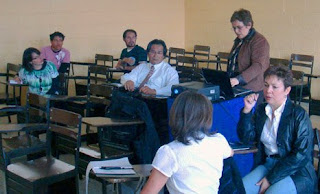 The Thematic Group on Comunication for Social Change is the only one that accepts within its members both researchers from universities and those that work closer to social practice and communication for development and social change projects. This enriches the discussions and the exchanges of experience and reflection. The Thematic Group plans to conduct joint research projects during the period of time –two years- that exists between two congresses, so presentations can become collective efforts. For that mater a web site was created with profiles of all participants and their papers, as well as a discussion platform in Google Groups, which allows the exchange of messages among group members. The Thematic Group on Comunication for Social Change is the only one that accepts within its members both researchers from universities and those that work closer to social practice and communication for development and social change projects. This enriches the discussions and the exchanges of experience and reflection. The Thematic Group plans to conduct joint research projects during the period of time –two years- that exists between two congresses, so presentations can become collective efforts. For that mater a web site was created with profiles of all participants and their papers, as well as a discussion platform in Google Groups, which allows the exchange of messages among group members.
Posted in University Network News | No Comments »
November 16th, 2008
 We did it again and the result is an impressive book: “Antologia de Comunicación para el Cambio Social: Lecturas Históricas y Contemporaneas”. Two years ago the Communication for Social Change Consortium published the book by Alfonso Gumucio-Dagron and Thomas Tufte in English, with 1060 pages and its red cover, the result of three long years of hard work. The world launching was in Rome in October 2006, during the World Congress of Communication for Development (WCCD) organized by the World Bank, FAO and The Communication Initiative, where a couple of thousand communication specialists from the world met. We did it again and the result is an impressive book: “Antologia de Comunicación para el Cambio Social: Lecturas Históricas y Contemporaneas”. Two years ago the Communication for Social Change Consortium published the book by Alfonso Gumucio-Dagron and Thomas Tufte in English, with 1060 pages and its red cover, the result of three long years of hard work. The world launching was in Rome in October 2006, during the World Congress of Communication for Development (WCCD) organized by the World Bank, FAO and The Communication Initiative, where a couple of thousand communication specialists from the world met.
Two years later, this year, on Friday 10th of October, we launched in México the Spanish edition of the ANTOLOGIA at the IX Congress of the Latin American Association of Communication Research (ALAIC), which is also the most important gathering of communication specialists in the region. It was an important occasion considering that ALAIC celebrated 30 years of existence. Alfonso Gumucio-Dagron and Thomas Tufte were there, as well as other authors included in the book, such as José Marques de Melo, Cicilia Peruzzo, José Cisneros, Gabriel Kaplún, Erick Torrico, Rosa María Alfaro and Jesús Galindo.
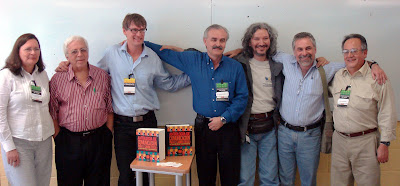 The Spanish edition of the book took additional two years. It includes 200 articles and excerpts from 150 authors worldwide. The translation of English texts to Spanish was done by Bertha Pancorvo, from Peru, and Alejandra Adoum from Ecuador took under her responsibility the copy-editing and read the whole ANTOLOGIA several times. Printing was done in La Paz, Bolivia, at Plural Publishers and the result is a beautiful book of 1414 pages, a hard-cover library book, high quality paper, with sewn and sturdy binding and a colorful cover. We can say it with no doubt: there is no other similar book in the world. The Spanish edition of the book took additional two years. It includes 200 articles and excerpts from 150 authors worldwide. The translation of English texts to Spanish was done by Bertha Pancorvo, from Peru, and Alejandra Adoum from Ecuador took under her responsibility the copy-editing and read the whole ANTOLOGIA several times. Printing was done in La Paz, Bolivia, at Plural Publishers and the result is a beautiful book of 1414 pages, a hard-cover library book, high quality paper, with sewn and sturdy binding and a colorful cover. We can say it with no doubt: there is no other similar book in the world.
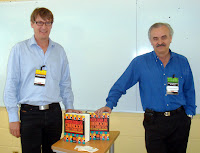 The reception of the book at ALAIC was significant; several reviews and interviews in specialized journals are on its way and will began appearing before the end of the year. The book will be launched again in Bolivia, by the end of November, during the international seminar “Local Radio: Policies and Legislation”. Additional national launchings are being organized in Ecuador, Colombia and Peru during the first quarter of 2009. The reception of the book at ALAIC was significant; several reviews and interviews in specialized journals are on its way and will began appearing before the end of the year. The book will be launched again in Bolivia, by the end of November, during the international seminar “Local Radio: Policies and Legislation”. Additional national launchings are being organized in Ecuador, Colombia and Peru during the first quarter of 2009.
Communication Schools all over Latin America and Spain have began purchasing the book for their libraries, as well as individuals, both academics and practitioners of the communication for development and social change field, who will use it as a reference book in their daily work. The distribution of the ANTOLOGIA is entirely by order through the Consortium website. The price is unbeatable for a book of such dimensions and content.
Posted in University Network News | No Comments »
October 28th, 2008
 We’ve been silent for a while. There are many reasons to it which are irrelevant now. What is important is the way forward, and we have decided to be more often with you through this blog. Rather than painfully crafting our modest bulletin every once in a while to include the news about the activities of our member universities, we will be now posting the news as the happen, in real time. So please, let us know about your activities as they take place and send us to this email a few paragraphs and illustrations that you would like to share with other members of the network. We welcome your contributions and will be updating the blog once or twice a week, giving priority to those news items that show collaboration between network members. We’ve been silent for a while. There are many reasons to it which are irrelevant now. What is important is the way forward, and we have decided to be more often with you through this blog. Rather than painfully crafting our modest bulletin every once in a while to include the news about the activities of our member universities, we will be now posting the news as the happen, in real time. So please, let us know about your activities as they take place and send us to this email a few paragraphs and illustrations that you would like to share with other members of the network. We welcome your contributions and will be updating the blog once or twice a week, giving priority to those news items that show collaboration between network members.
One of the additional advantages of using this blog site to share information is that we will be able to include other colleagues from universities that may not yet be part of the University Network but have a common interest in studies on communication for development and social change. Our distribution list will thus be able to expand without limits.
We have much to include here, many activities have been going on during the past few months. There is a wealth of information in our files which we will be releasing during the next weeks until we do catch-up with all the pending releases.
But for now, since this is the first posting and will be reaching new colleagues all over the world, we will briefly remind everyone that the University Network News is the humble bulletin that has been issued since April 2006 to keep network-members informed. Nine issues of the Network News Bulletin were issued since, that can be found at the Communication for Social Change website.
 The University Network itself was created during our meeting of universities in Los Baños, The Philippines, in September 2005. Faculty and graduate students from 12 universities in Asia, Africa, Europe, North America, Latin America and The Caribbean, all with specialised degree programmes in communication for social change and development met at the invitation of the Communication for Social Change Consortium to discuss their programmes of study. On the last day of the gathering facilitated by the College of Development Communication, the oldest in the world, there was a collective decision to create the University Network, facilitated by the Consortium. The University Network itself was created during our meeting of universities in Los Baños, The Philippines, in September 2005. Faculty and graduate students from 12 universities in Asia, Africa, Europe, North America, Latin America and The Caribbean, all with specialised degree programmes in communication for social change and development met at the invitation of the Communication for Social Change Consortium to discuss their programmes of study. On the last day of the gathering facilitated by the College of Development Communication, the oldest in the world, there was a collective decision to create the University Network, facilitated by the Consortium.
 The “ Los Baños Statement”, a document that all universities signed, including the objectives, the activities sought and the vision of the network can be also accessed in our website.
The universities that initially joined the network are: the College of Development Communication (The Philippines), Pontificia Universidad Católica del Peru (Peru), Universidad Andina Simón Bolivar (Bolivia), Ohio University (USA), University of Guelph (Canada), Universidad del Norte (Colombia), Universidad Nacional de La Plata (Argentina), University of the West Indies (Jamaica), Malmö University (Sweden), Roskilde University (Denmark), University of Zambia (Zambia), G B Pant University of Agriculture and Technology (India). Others have joined in recent years, which we will be portraying in this blog every month.
Posted in University Network News | No Comments »
|
|
 |




 Two universities that are members of the University Network initiated their collaboration recently.
 Furthermore, Jair Vega and Thomas Tufte discussed modalities of research cooperation in the context of the ‘International Research Network for New Thinking on Citizenship, Authority, and Public Space in Latin America’. This is a Danish-funded research network which is enabling the development of research applications for the Danish Research Council of Social Sciences.


