



The Anthology in Bogota
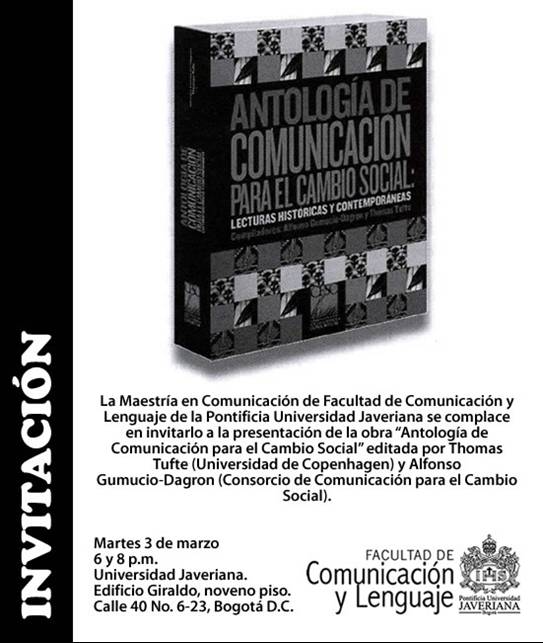 The launch of the Antologia in Bogota took place on March 3, 2009 with the auspice of the University Javeriana, in the presence of the Dean of the Faculty of Communication and Language, Jürgen Horlbeck, the Director of Communication, Antonio Roveda, Professor Amparo Cadavid, as well as Alfonso Gumucio Dagron and three Colombian authors included in the Anthology, Jesus Martin Barbero, Sonia Fraser-Restrepo and José Miguel Pereira.
Jurgen Horlbeck called the Anthology “a mammothret” and did an interesting digression on the etymology of the word, indicating that in late Greek, and then in late Latin “mammothreptus” signifies “raised by the grandmother”, therefore a very well suckled and fed, and supposedly chubby and strong infant. He alluded to the monumental dimensions of the work, the effort and the fine care that was invested, as well as the time spent on it. He added that the book would have an important function in the university, exactly because it would “feed those who dare to consult it”.
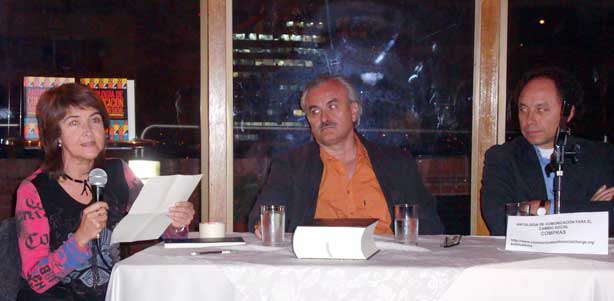 According to Professor Cadavid, who intervened immediately after, the book is “a complete ’state of the art’ that covers practically all that has been produced in five continents” in the field of communication for the development, “with a level of refinement in the selection of contributions that are pertinent to enrich this field“. In her recount of authors, she mentioned that nine are Colombian: Jesus Martin Barbero and José Miguel Pereira reside in the country, though this is not the case for Clemencia Rodriguez, Arturo Escobar, Sonia Fraser-Restrepo, Carlos Cortés, Rafael Obregón and Pilar Riaño. The social scientist Orlando Fals Borda passed away before seeing published the work in Spanish.
Finally Jesus Martin Barbero, worldwide recognized Latin-American author, thanked Gumucio Dagron and Tufte “for having been capable of including so many voices and to weave them together. This book is a weaving of multiple voices, with an enormous presence and power of Latin American thinking, and this is key, really key from our countries towards the rest of the world“.
 He added that “the book has two bets: the first one to think about the transformation of society and the second, to think it from the communication perspective not as a technique -which today is the obsession of the vast majority of communication faculties in Latin America, too attentive to the market who dictates brazenly how to educate communicators. For me and all those that have been fighting for this cause for almost 40 years, to find this global book, in the best sense of the word, which places in the centre social change and the weaving of the realities of which communication is made -much more than media-, is an enormous satisfaction“.
“As insinuated by Alfonso, there has been a pioneering thinking for a long time in Latin America, but the North continues looking at us from above. There is a precious expression by Appadurai: ‘They continue thinking of us as providers of raw materials for the north theoretical mills’“, he added.
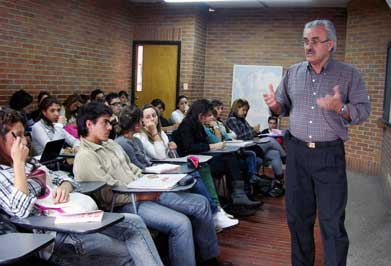 “Justice is done now, I mean it with pride also because Thomas Tufte, (although being Danish, has spent much time in Brazil and other places of Latin America) identifies himself with the perspective from which we work in this region. And in this book what we find, really, is a bet for dialogue between the world and Latin America. It places Latin America in the world and allows the world -in the English version - to learn that here we don’t just produce raw materials so that the mills in the North can grind them; here we are not only native informers on the exotic forms of communication of Latin America; here we have as much thinking or more. However, it is a pity that this is not only problem of northern countries, but of the majority of communication faculties in Latin America; every time bibliographical research is done, save four or five of us that are rewarded, there is an enormous quantity of cheap bibliography of signatures with a lot of market in the north.“
…///