



Launching and field visits in Cali
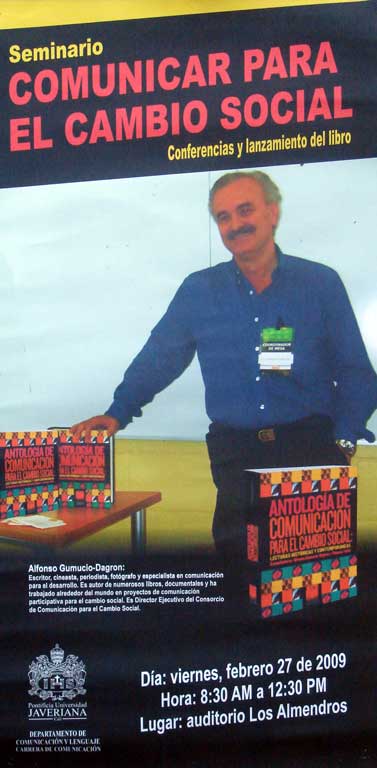 The ANTOLOGIA in Spanish has been recently launched in Colombia, this time in two main cities, Cali and Bogota, thanks to the invitation of Universidad Javeriana de Bogota and Universidad Javeriana de Cali, two main academic institutions in Colombia who jointly organized the events.
The first launching took place in Cali, vibrant city in the Southwest of Colombia, where Alfonso Gumucio Dagron was invited to participate in a number of activities around the presentation of the ANTOLOGIA: meetings with scholars and students, interviews, visits and exchanges with participatory communication projects. All activities were coordinated by two dynamic professors of the Universidad Javeriana de Cali, Fanny Franco and Mónica Marión, who have been instrumental in developing a communication for social change approach with their students.
On Thursday February 27th during a half day workshop for faculty of the Communication Department Alfonso Gumucio did a presentation on “Communicating for social change”, the roots and evolution of the theoretical framework of this field of research currently in construction. A discussion with communication professors followed.
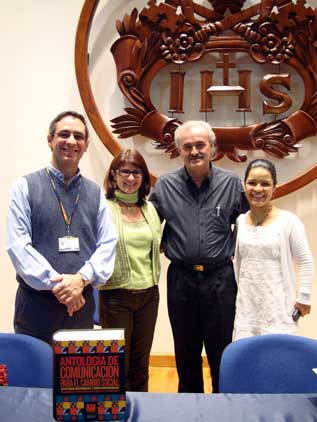 In the evening a one-hour interview conducted by Father Gabriel Jaime Perez, Vice-Chancellor of the University, Fanny Franco and Mónica Marión was recorded at the university radio station, Javeriana Estereo 107.5 FM. A write-up of the interview will be published in the next issue of the indexed academic journal “Signo & Pensamiento”.
For the launching of the Antologia, another half-day workshop on Friday February 28th, gathered communication students and faculty from the main universities in Cali, including Universidad del Valle, Universidad Santiago de Cali, Universidad de Occidente and Universidad Santo Tomas. The Dean of the Communication and Language Department of Universidad Javeriana, José Vicente Arizmendi, and the Director of the Faculty of Communication, Jorge Manrique, opened the seminar with speeches followed by presentations by Professors Marión and Franco. Alfonso Gumucio spoke on why and how the Anthology was developed.
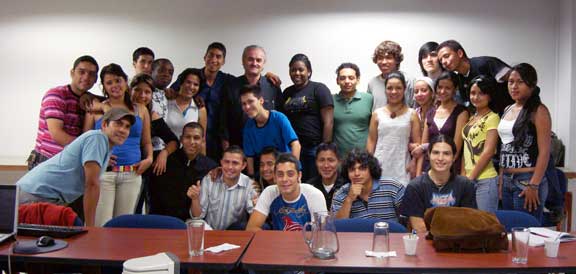
 The afternoon was devoted to visiting youth groups working on social issues using the communication for social change approach of dialogue and participation. The first group, Sistema Departamental Juvenil de Comunicacion (Departmental Youth Communication System) gathers about 30 young communication activists from various cities and rural areas within the Valley Department of Colombia. They meet regularly to take forward a communication process that is inclusive and allows young men and women from different social strata to discuss and design their own strategies. They use video and radio to express their issues. Many of them mentioned that their training benefited from texts such as “The New Communicator” and “Making Waves”.
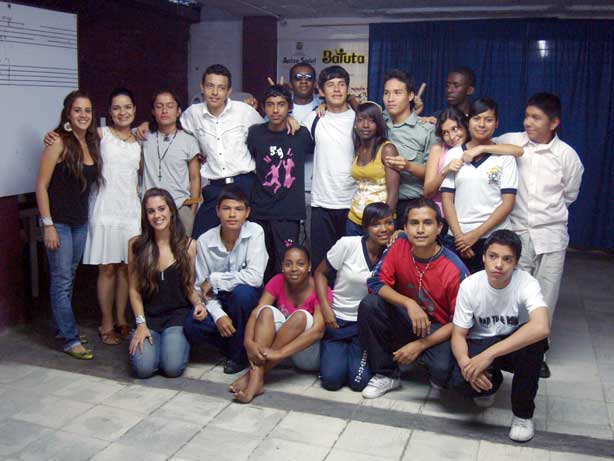 A visit to the poor neighbourhood of Agua Blanca followed where “Movimiento Latino”, the youth drama group, was rehearsing a play on violence and drug dealing, a topic particularly important in this region of Colombia. When asked about their understanding of theatre as communication, they emphasized that in only a couple of years it had transformed their lives and had the potential to transforming their community as well.
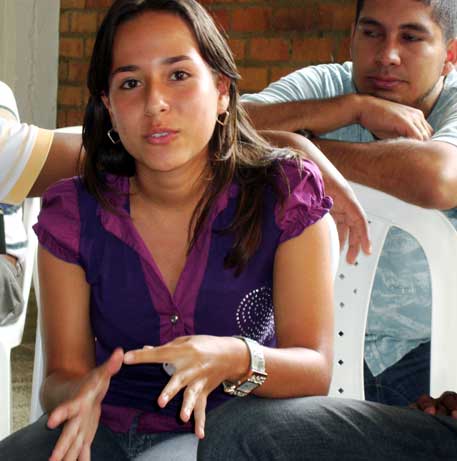
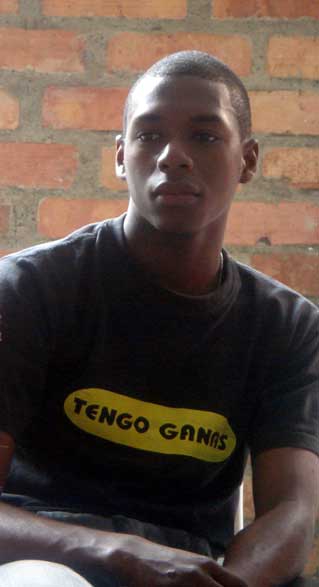 On the third day of activities two additional visits were programmed, the first in Santander de Quilichao across the border of the Cauca Department, a town located about one hour drive from Cali, where another youth group, named “Tengo Ganas” (”I want to…”) has been producing short video-clips on issues that affect their community, such as environmental care, peer pressure, self-esteem, or violence, underscoring the values of peace, understanding and solidarity. The Mayor of the city participated in the meeting and highlighted the value of supporting youth organizations.
The three communication projects described above are developed in partnership with students from Universidad Javeriana de Cali, who spend weekends providing support to the youth groups, using a communication for social change approach.
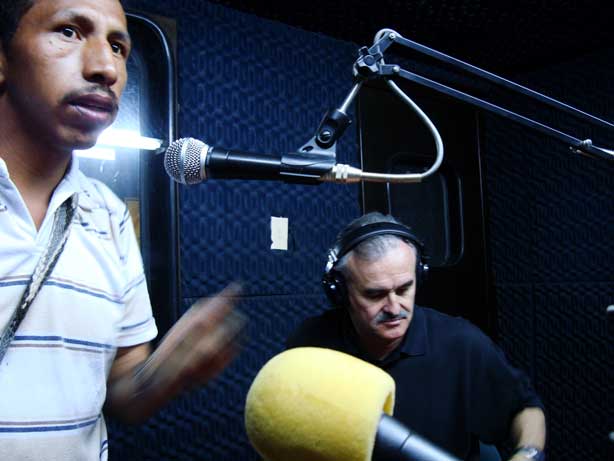 The journey continued higher into the hills to Caldono where one of the main Colombian organizations of native indians, the CRIC, has set up an audio-visual production centre and a community radio station, Uswal Nasa Yuwe. Vicente Otero, a leading figure in communication within the indigenous organisations, explained the strategy that has lead to impressive demonstrations demanding more rights for indigenous communities in Colombia. Participatory communication has played an important role.
Still a couple of hours ahead, in the historic Popayan, the capital city of the Cauca Department, another meeting was scheduled late in the afternoon with Giezzi Lasso, Director of the Communication Programme at the Universidad del Cauca, and several professors to exchange views about their curricula, which is about to be reviewed in the perspective of including a communication for development and social change approach.
In our next blog-note we will provide information about the launching of the ANTOLOGIA in Bogota.
…..—–