



Local Radio: Policies and Legislation
The International Seminar “Local Radio in Latin America: Policies and Legislation” took place last 19-21 November 2008 in La Paz, Bolivia, at the Universidad Andina Simón Bolívar, one of the universities of this network. Fifteen international guests, specialists in the subject matter, attended, as well as one hundred Bolivian participants, among them communication professors and students, local radio stations journalists and managers, and representatives from development institutions.
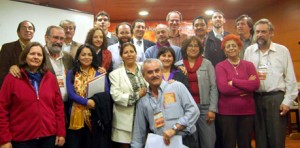
Bolivian and international participants
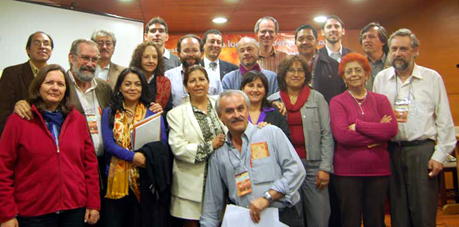
Among the international participants, Cicilia Peruzzo (Brazil), Jose Ignacio Lopez Vigil (Cuba/Ecuador), Rosa María Alfaro (Perú), Jeanine ElGazi y Omar Rincón (Colombia), Thomas Tufte (Dinamarca), Christoph Dietz (Alemania), Aleida Calleja (México), and Gustavo Gómez (Uruguay).
Community radio in Latin America, a pioneer worldwide, has contributed in processes of peace and justice, in strengthening social movements and social organisations, and in the struggle for liberties and human development. Since they started late in the 1940s local radio stations were often born illegal, prompted by poor social sectors of society, and were socially legitimised because of their undeniable service to the public and the sectors they serve.
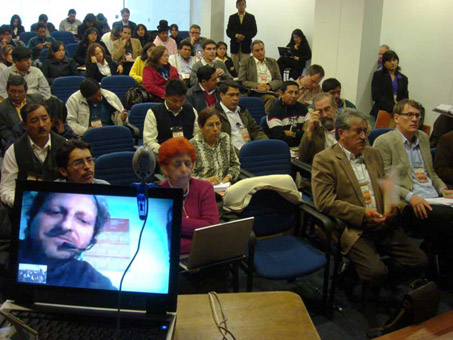
Video conference with Manuel Chaparro from Spain
As time went by, the need for legal recognition of these independent local initiatives became more pressing, not only because of their social function but also as a means to meet the demand for the right to communicate with cultural and social pertinence, from spaces generated through state-owned, private and public media within the framework of democratic political systems.
Battles were fought throughout the region for the creation and/or revision of communication policies with a public service content, and legal frameworks and regulations that would recognise, protect and promote the development and operation of local media. National and regional organisations such as AMARC have leaded this movement.
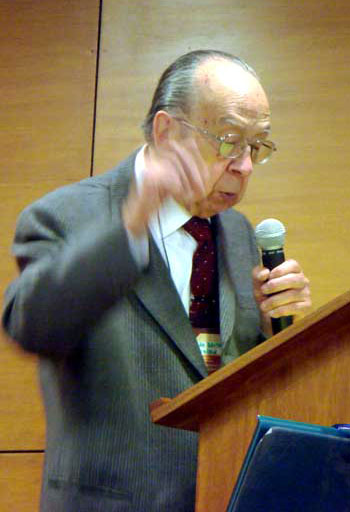
Luis Ramiro Beltran
In spite of it, both in Latin America and the world, very peculiar situations coexist depending on the political and social context of each nation. Some countries have taken the lead in designing policies and legislation for local radio (Uruguay, Colombia), whereas others lack of mechanisms protecting and promoting community media (Bolivia, Guatemala) or have enacted legislation that limit, instead of promoting, the exercise of communities right to communicate (Brazil, Chile).
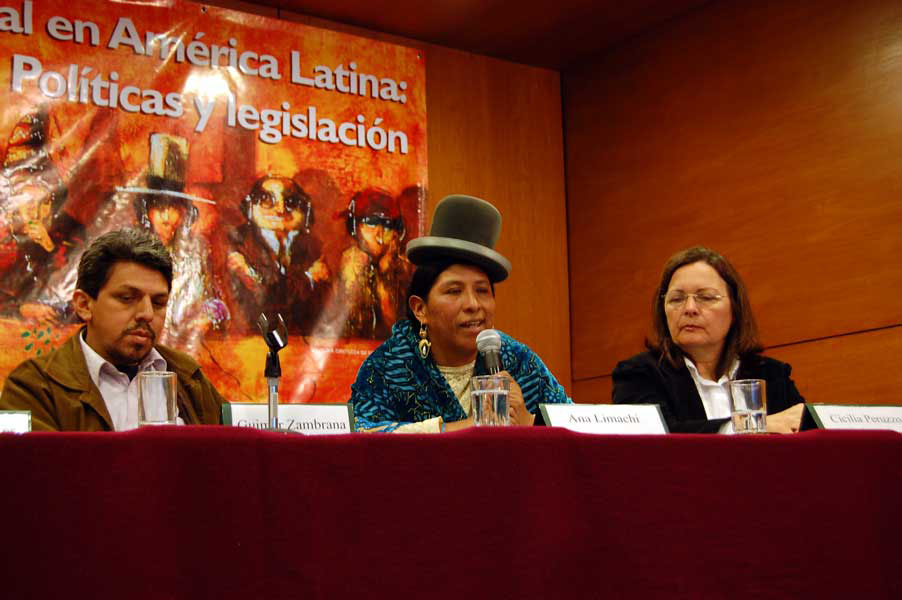
Guimer Zambrana, Ana Limachi and Cicilia Peruzzo
The main objective of the seminar was to review the processes of political incidence favouring local media, and its degree of advancement, reflecting on the new political contexts that could strengthen, or weaken, the legitimacy of these media; as well as to draft recommendations on policies and legislation and present them to national authorities, relevant social sectors and other organizations.
During the week parallel activities were conducted: un documentary film cycle on local radio stations in various parts of the world, among which several Consortium video productions were shown, such as “Voices from the Magdalena” (Colombia) and “Women of Pastapur” (India); and the launching of the Spanish edition of “Antologia de Comunicación para el Cambio Social: Lecturas Históricas y Contemporaneas” at Plural Editores.
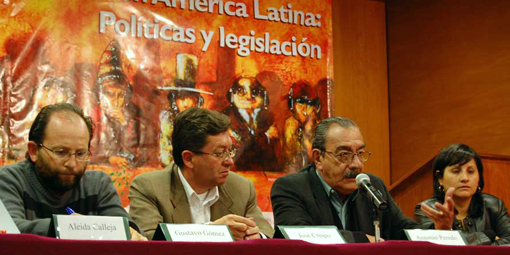
Congresman Antonio Peredo at the final plenary
Based on recommendations from the working groups, a commission drafted the final document of the seminar, “Carta de La Paz” (Letter from La Paz), which was presented at the final plenary with attendance of Congressman Antonio Peredo Leigue.
——